Where our licorice comes from
Bogot Master digs wild licorice root, Glycyrrhiza glabra, across the Khorezm region of Uzbekistan, and processes and ships it from Bogot district. This page sets out where the root comes from, the permit it is dug under, and what the published research does not show.
Bogot district, Khorezm region
Our site is in Bogot district, Khorezm region, in the north-west of Uzbekistan. The district's name is written Bogʻot in Uzbek, and Bagat in some English and Russian sources (Багатский район); our documents and this site use Bogot.
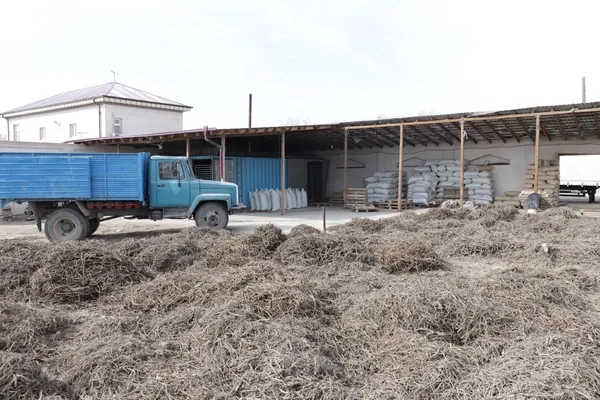
Bogot Master is a family company, founded in 2014. More than 20 people work in harvesting, processing, packing and logistics, and we export more than 500 t of root a year. Every load is prepared at our site: the root is cleaned, cut, dried, sorted and packed there, and each product page lists its own steps. Loads leave by truck from the site, or by rail from Urgench railway station.
The plant
We supply one species, Glycyrrhiza glabra L. Uzbekistan lies inside its native range, and the deltas of the Amu Darya in Khorezm and Karakalpakstan are among the areas named for natural licorice in the country (Khaitov et al. 2022). The plant's botany, its range and how it differs from the other licorice species of trade are covered in our article on the plant; its section 7 deals with Khorezm and the lower Amu Darya.
Where the root is dug
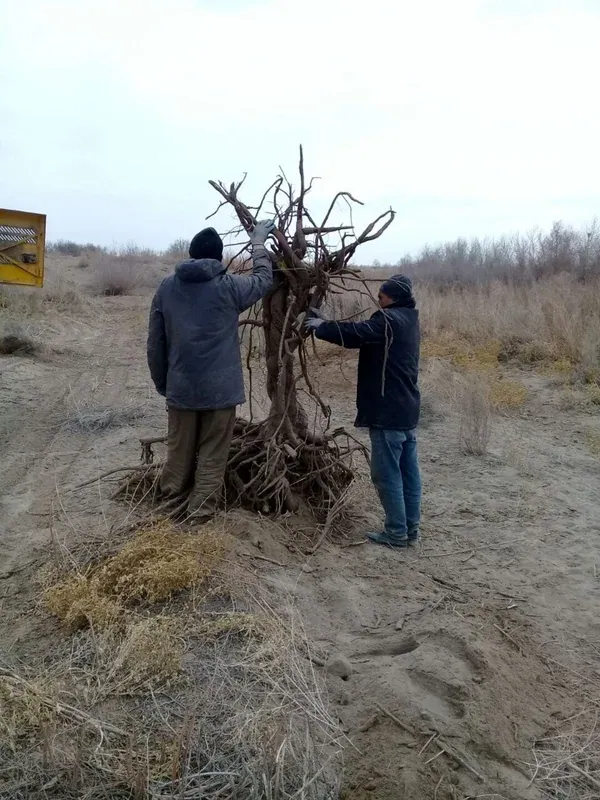
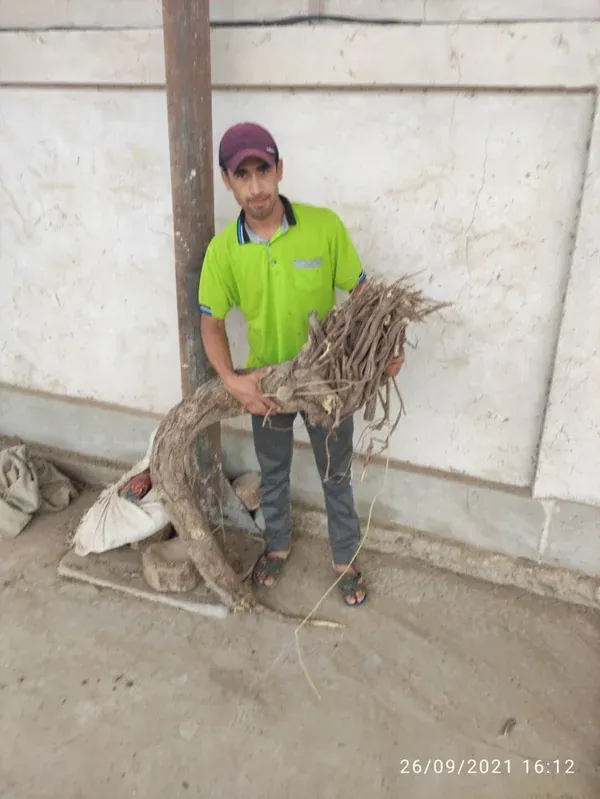
The root is wild. It is dug across the whole of Khorezm region, all year round; digging stops only in extreme cold, about 3–4 days a year. The root is brought to our site in Bogot district for processing.
Specimen records confirm that the species grows here. The Global Biodiversity Information Facility (GBIF) holds 16 records of G. glabra from Khorezm. Fourteen of them are herbarium specimens collected in 2024 in Bagat (Bogot), Khanka and Yangibazar districts and held by the Academy of Sciences of Uzbekistan, some of them labelled from the Amu Darya itself. GBIF holds no record from Khorezm of the other two licorice species of trade, G. uralensis and G. inflata (GBIF.org 2026). The records show where the species was collected, not how much of it grows: no estimate of the area or root stock of licorice in Khorezm was found, and most of the records come from one collection devoted to G. glabra, so they cannot show that the other species are absent.
Wild, not cultivated
All our root is wild-dug; none is cultivated, so there are no separate wild and plantation lots.
The difference matters in this region. An official account of a 2018 presidential meeting set the aim of moving from the collection of wild root to organised plantations (Press Service of the President 2018). A 2018 resolution provides for up to 25,000 ha of licorice plantations in Karakalpakstan (Cabinet of Ministers 2018), and since 2022 the "one district, one product" scheme has assigned licorice to every district of Khorezm and Karakalpakstan (President of the Republic of Uzbekistan 2022). Licorice root from the region may therefore be wild or plantation-grown, and a buyer can ask which.
Studies elsewhere report less glycyrrhizin in cultivated root than in wild root (Hayashi et al. 2016; Khaitov et al. 2022). None of them concerns Uzbek plantations or is known to have controlled plant age and site, so this is not a measured difference for this region.
The harvest permit
Wild licorice in Uzbekistan is dug under a permit. Ours is issued by the National Committee of the Republic of Uzbekistan for Ecology and Climate Change. The country's rules on permits for using wild plants give raw licorice root its own code, 1211 90 860 8 (see import rules and HS codes).
At export, each load travels with a phytosanitary certificate and a certificate of origin on GSP Form A, with origin criterion "P": wholly obtained in Uzbekistan. The other documents are listed on the shipping page.
What is not known
- Glycyrrhizin and place. We know of no evidence that Khorezm's soil or climate raises the glycyrrhizic acid content of the root, and we do not claim it. The only chemical field survey of Uzbek licorice that we found studied one habitat, whose location the abstract does not give. It found 3.3–6.1 % glycyrrhizin in single samples, on both sides of the European Pharmacopoeia's 4.0 % minimum, which applies to a lot, not to a single root (Hayashi et al. 2003). No root assay from a named site in Khorezm was found. The figure for our root is on each load's certificate of analysis.
- The size of the stands. No estimate of the licorice area or stock in Khorezm was found. Wild licorice has declined along the river: a 2025 study classed four of six G. glabra populations in the Amu Darya basin as old (Saribayeva et al. 2025), and in Karakalpakstan, downstream, natural licorice habitat is reported to have shrunk from 38,000 ha in the 1960s to 6,500 ha in 2020 (Khaitov et al. 2022).
- Species and hybrids in the stands. No survey of the species make-up of the Khorezm stands, or of hybrids in them, was found. The identity of the root rests on specimen records and on testing each lot. In the 2003 survey, every underground sample contained glabridin, the marker compound of G. glabra (Hayashi et al. 2003).
Checking it yourself
Because the research leaves these gaps, the check is on the root itself:
- Samples: free for companies, 100–200 g of each grade.
- Each load: a certificate of analysis from a professional laboratory in Uzbekistan that you can choose. It always covers glycyrrhizic acid, ash and moisture, and the laboratory adds an identity test or any other test you name.
- Visits and audits: welcome. We help with the visa and the hotel, meet you at the airport and show you round our site.
Sources
- Cabinet of Ministers of the Republic of Uzbekistan (2018). Resolution No. 63 of 27 January 2018, on the further development of the production and industrial processing of licorice and other medicinal plants. lex.uz/acts/3540251
- GBIF.org (2026). Occurrence records of Glycyrrhiza glabra, G. uralensis and G. inflata, with counts for Uzbekistan by province. The Khorezm specimens are in the dataset "Natural sources and associated problems of Glycyrrhiza glabra L." of the Academy of Sciences of the Republic of Uzbekistan, doi:10.15468/uteq7p. Read in October 2026.
- Hayashi, H. et al. (2003). Field survey of Glycyrrhiza plants in Central Asia (3). Chemical characterization of G. glabra collected in Uzbekistan. Chemical and Pharmaceutical Bulletin 51(11): 1338–1340. doi:10.1248/cpb.51.1338. Abstract only.
- Hayashi, H. et al. (2016). Field survey of Glycyrrhiza plants in Central Asia (4). Characterization of G. glabra and G. bucharica collected in Tajikistan. Biological and Pharmaceutical Bulletin 39(11): 1781–1786. doi:10.1248/bpb.b16-00251. Abstract only.
- Khaitov, B. et al. (2022). Perspectives of licorice production in harsh environments of the Aral Sea regions. International Journal of Environmental Research and Public Health 19(18): 11770. doi:10.3390/ijerph191811770
- President of the Republic of Uzbekistan (2022). Resolution No. PP-251 of 20 May 2022, on organising the cultivation and processing of medicinal plants. lex.uz/ru/docs/6027149
- Press Service of the President of the Republic of Uzbekistan (2018). Report on the meeting of 6 February 2018 on the development of the pharmaceutical industry. president.uz
- Saribayeva, S.U. et al. (2025). Analysis of Glycyrrhiza glabra L. coenopopulations in the Amudarya River basin under global climate change. Plant Science Today 12(3). doi:10.14719/pst.3445. Abstract only.
The wider evidence, with every source, is in our article on the plant.