How we process licorice root
Every load is prepared at our site in Bogot district, Khorezm. More than 20 people cut, clean, dry, sort and pack the wild root there, and we export more than 500 t of it a year. This page follows the root from delivery to the truck, and names the check made at a step wherever there is one. Each product page lists the steps for that product, in order; the table at the end puts them side by side.
1. The raw root arrives
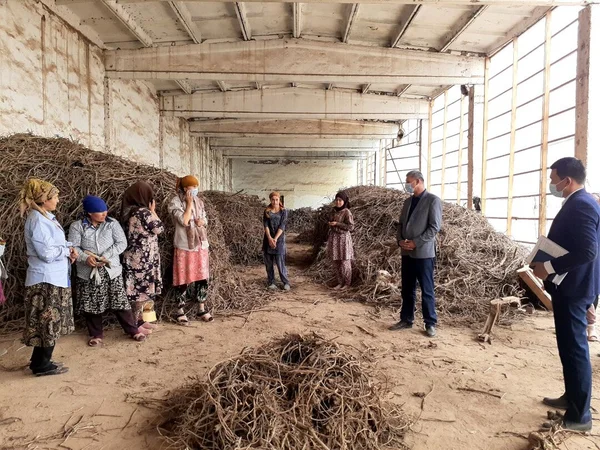
Wild root is dug across Khorezm all year round and brought to our yard (see where our licorice comes from). It is kept under cover until it is processed.
The raw root is cut into long sticks and sorted into large sticks, small sticks and thin root. The sticks become the export products. The thin root, under about 7 mm, is kept apart and sold as the extraction grade.
Checked at this step: stems, leaves and the roots of other plants are taken out of the licorice root. The thin root stays out of the other products: granules, crushed root, root fibre and powder are made without it, unless your specification accepts it at a lower price.
2. Washing
Root for slices, tablets and the industrial grade is washed by machine. Granules, crushed root, root fibre and powder are made from this washed root once it is dry.
Sticks and fingers are usually not washed. If you ask for it, they are washed as sticks, before they are cut. Peeled products need no washing, because the dirt comes off with the bark. The extraction grade is not washed.
3. Peeling
For peeled sticks, peeled fingers and peeled granules, the bark is removed by hand or by machine. The peeling machine works the way a wire-stripping machine does on a cable.
4. Steaming
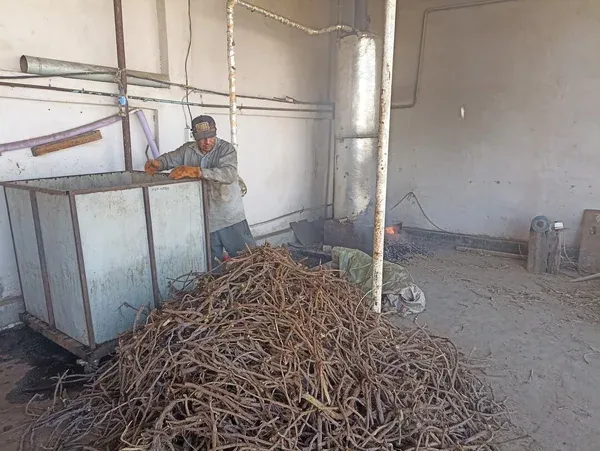
Root that is cut by machine into slices, tablets or industrial-grade pieces is steamed first, so it cuts cleanly and keeps its colour. The root is soft only while it is hot; once it cools, it is as tough as before.
Steaming is not a sterilisation step. Hand-cut sticks and fingers are not steamed, the extraction grade is not steamed, and granules, crushed root, root fibre and powder have no steaming step of their own.
5. Cutting
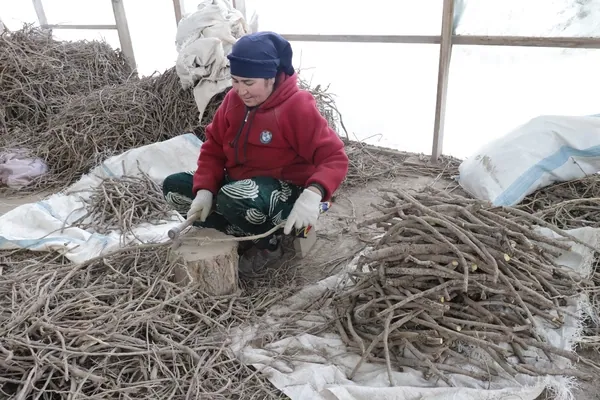
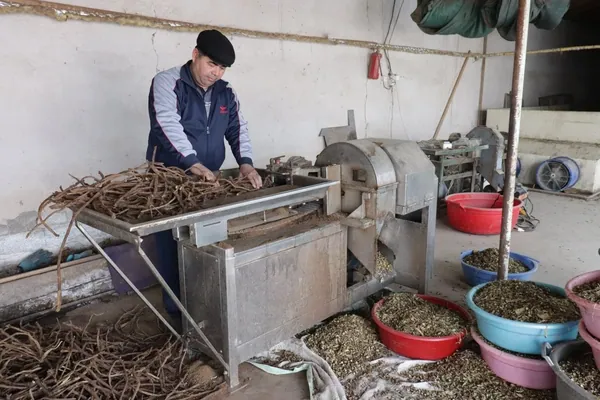
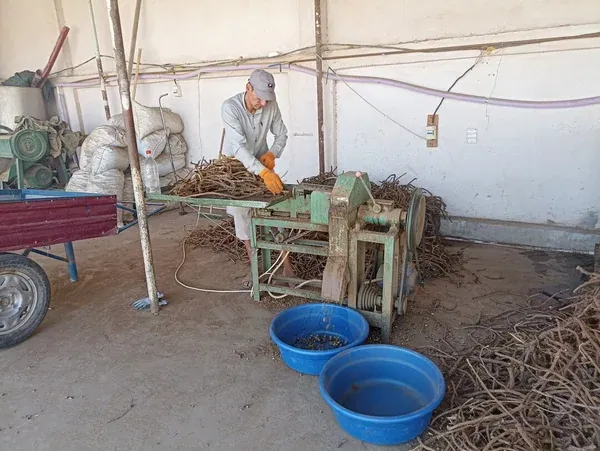
Sticks and fingers are cut by hand. Everything else is cut by machine:
- Slices are cut at a shallow angle. The long cut leaves long fibres, so a slice holds together when it is boiled, as traditional Korean dishes need. Slices L are cut from large sticks and slices S from small ones.
- Tablets are cut at 90°.
- The industrial grade is cut into pieces under 5 cm, and the extraction grade roughly into pieces of 2–5 cm.
- Granules, crushed root, root fibre and powder are cut, crushed or milled from dried pieces, mostly offcuts and tablets.
The sizes below are those in each product's specification:
| Product | How it is cut | Size |
|---|---|---|
| Slices, every grade | Machine, at a shallow angle | 5–7 mm thick |
| Tablets | Machine, at 90° | 3–4 mm thick |
| Granules | Machine | 3–4 mm |
| Crushed | Machine | 2–3 mm |
| Root fibre | Machine | 2–4 mm |
| Powder | Mill | 1 mm or less |
| Fingers | By hand | 5–8 cm long |
| Sticks and peeled sticks | By hand | 45–55 cm long |
| Standard sticks | By hand | To your order |
| Industrial grade | Machine | Under 5 cm |
| Extraction grade | Machine, roughly | 2–5 cm |
How to choose between the forms and grades is covered in the guide chapter choosing a form and grade.
Checked at this step: the cut length. The knife blades are sharpened three times a day, and the cut length is checked after each sharpening.
6. Drying
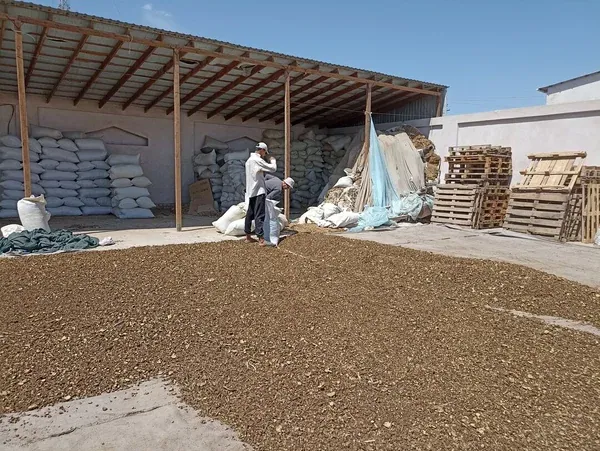
In summer the cut root dries in the open air, spread on tarps on our concrete yard. Slices dry in the shade, because the sun slowly fades their colour. Tablets can dry in the sun: a slight fading of the outside does not matter for their uses.
On overcast summer days the root goes into air-circulation dryers, without heat. In winter, and in cold or rainy weather, it dries in a heated dryer. The thin extraction-grade root is dried in the open air.
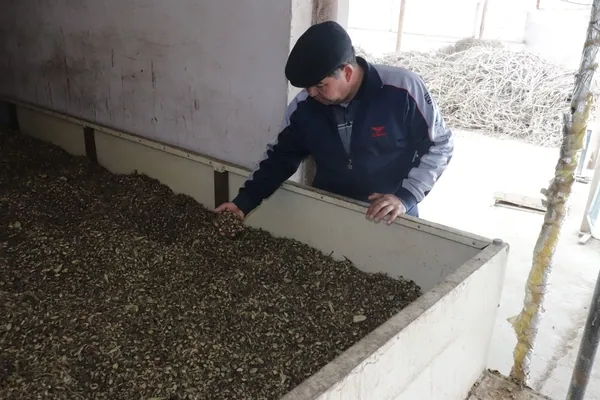
Checked at this step: moisture. We check it on site with a moisture analyser: a scale with a heating lamp, which weighs a sample, heats it to 105 °C until its weight stops changing, and gives the moisture from the weight lost. The specification allows at most 12 %, and the laboratory also measures the moisture of every load (see testing each load).
7. Sorting and cleaning
- Slices A, B, C and C1 are sorted by diameter and picked over by hand. Because the sorting is by hand, the ranges are approximate: B is about 20–30 mm, C about 10–20 mm. Slices L and S are cut from separate sticks and never mix, so they are only sieved.
- Tablets and the other graded products are sorted by size over sieves with round holes, of 12 mm, 16 mm and so on.
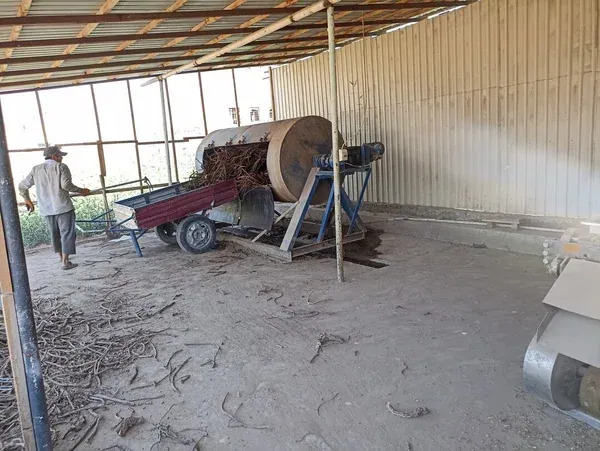
- Sticks and fingers are cleaned in a rotating drum sieve, whose round holes are a little smaller than the pieces. The pieces rub against each other, and the dust and dirt fall out through the holes.
- Almost every other product goes over a sieving machine, which removes the dust left by cutting. A magnet at the machine's bag collector catches any metal.
Checked at this step: size, by hand or by the sieve's holes; metal, by the magnet; and foreign matter, by hand picking and sieving. The specification allows at most 1 % foreign matter.
8. Packing and lot numbers
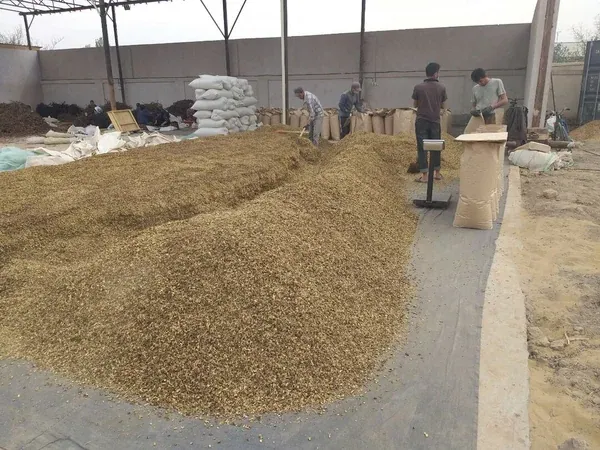
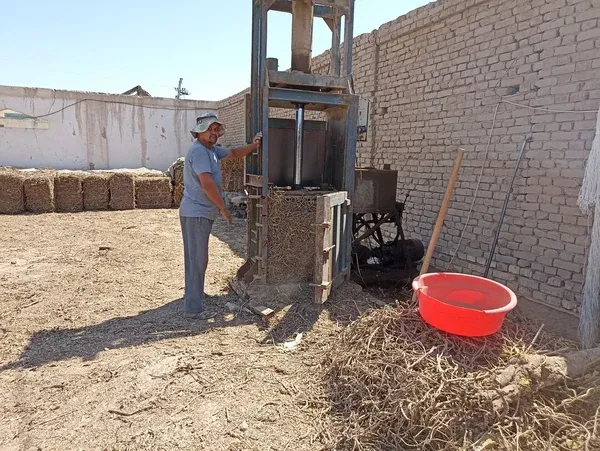
Our standard packing is polypropylene (PP) bags of 20, 21, 25 or 30 kg. Packing is also made to order, at your cost: paper bags, inner liners, pallets, bags printed with your logo or any other packing you specify. Sticks, about 50 cm long, can be pressed into bales of about 120 kg; fingers always travel in bags. Extraction-grade root can be pressed uncut into cubes of about 110 kg, so a truck carries more of it.
Each bag is filled and weighed on a scale. A load has one lot number, the same on the bags, the invoice, the packing list and the certificate of analysis. We keep a sample of each shipment for one year, so a question about a load can be checked against it.
Checked at this step: the weight of each bag, and the lot number.
For your own storage, keep the root at or below 25 °C, in a cool, dry place away from sunlight. Shelf life is 36 months from the production date.
9. Fumigation and dispatch
Every load is fumigated with phosphine (aluminium phosphide) once it is loaded, before it leaves, and a fumigation certificate travels with it. The root is never irradiated.
Loads leave by truck from our site, or by rail from Urgench railway station: 11 t in a 20 ft container, or 22 t in a 40 ft container or a tent truck. Routes, Incoterms and documents are on the shipping page.
Testing each load
We have no laboratory of our own. Every export load has a certificate of analysis from a professional laboratory in Uzbekistan, and you can choose the laboratory. It always covers glycyrrhizic acid, ash and moisture. The laboratory adds microbiology, heavy metals, pesticide residues or any other test you name in your enquiry.
Buyers also test loads against their own specifications. Before you order, you can test a free sample of 100–200 g per grade, and you are welcome to visit or audit our site.
What the process does not include
- No step to reduce microbes. Steaming is for the cut and the colour, and the root is neither sterilised nor irradiated. If your specification sets microbiology limits, name them, and the laboratory tests the load.
- No claim about glycyrrhizic acid. We do not claim that any step raises or preserves it. The figure for each load is on its certificate of analysis; content tends to follow root diameter and harvest season, so lots richer in glycyrrhizic acid can be selected on request.
- No food-safety certificate. We hold no HACCP, ISO 22000 or FSSC 22000 certificate yet. The check is on the root itself: the certificate of analysis, your own tests, samples and visits.
Which steps each product goes through
| Product | Washed | Steamed | Cut | Sorted and cleaned |
|---|---|---|---|---|
| Slices A, B, C, C1 | By machine | Yes | Machine, shallow angle | By hand |
| Slices L, S, Mix, D | By machine | Yes | Machine, shallow angle | Sieving machine |
| Tablets | By machine | Yes | Machine, 90° | Round-hole sieves |
| Granules, crushed, root fibre, powder | Made from washed root | No | Machine or mill | Sieving machine |
| Peeled granules | Peeled instead | No | Machine | Sieving machine |
| Fingers, sticks | On request | No | By hand | Rotating drum |
| Peeled fingers, peeled sticks | Peeled instead | No | By hand | Rotating drum |
| Industrial grade | By machine | Yes | Machine, under 5 cm | Sieving machine |
| Extraction grade | No | No | Machine, roughly | Sieving machine |
Most products are dried after cutting. The extraction grade is dried first and then cut, and granules, crushed root, root fibre and powder are made from root that is already dry. Slices dry in the shade. A product page gives its own steps in full: for example, Slice A or Fingers.